What's Inside This Guide
I spent weeks watching my own front hall turn into a shoe graveyard. Keys buried under mail. A leash tangled around a reusable bag. The problem wasn't that we were messy. It was that the entryway had no job description. Most entryway organization advice tells you to buy a bench and call it a day. That misses the real issue: every item crossing your threshold needs a landing spot that takes less than three seconds to use. If it takes longer, the pile wins.
Here are the seven fixes I've tested in a 34-square-foot entryway, plus what I'd skip. This isn't a shopping list. It's a system you can set up in an afternoon.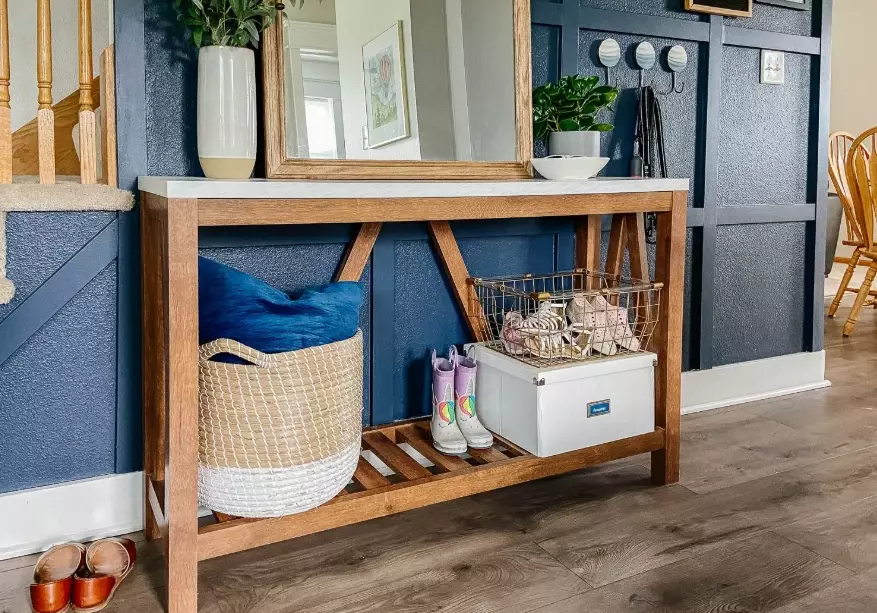
Why Your Entryway Fails (It's Not the Mess)
Newcomers blame clutter. I blame the friction gap—the distance between the door and the first surface where you can drop something. If that gap is more than one arm's length, stuff lands on the floor.
In my first apartment, the door opened directly into the living room. No landing zone. Coats went over chair backs. I installed a wall hook strip 10 inches from the door frame. The pile vanished in two days. The lesson: position beats pretty.
Another non-obvious mistake: putting the shoe rack inside a closet. I've seen this in dozens of homes. You won't open a closet door every time you walk in. The rack needs to sit in the open, even if it's ugly. Choose function over design here.
The One-In-One-Out Shoe Rule
Shoes multiply at the door. My rule: for every pair that enters the entryway, one pair leaves for the bedroom closet. Not the garage. The bedroom. Why? Because the garage becomes a second entryway within a month.
I keep a small bin labeled "Return" next to the bench. At the end of each week, I carry it back to the bedroom closet. Takes four minutes. Without this step, the pile returns. I've watched it happen three times.
Limit entryway shoes to two pairs per person. One for outside, one for inside. That's it. Anything more is storage, not entryway.
| Shoe Category | Entryway Allowed | Where It Lives Instead |
|---|---|---|
| Daily sneakers | 1 pair | Bench shelf |
| Work boots | 1 pair | Boot tray by door |
| Seasonal extras | 0 pairs | Bedroom closet bin |
| Guest slippers | 2 pairs max | Basket under bench |
| Sports cleats | 0 pairs | Garage hook or mudroom locker |
Small Entryway Storage Wins
If your entryway is narrow—mine is 41 inches wide—skip the bench with cubbies. The depth eats your walkway. Instead, mount a shallow shoe cabinet (8 inches deep max) and add a wall-mounted hook rail above it. I used a 24-inch rail with five double hooks. Holds two coats, a leash, and a tote. Total cost: under $40 at a hardware store.
Another win: a magnetic key holder on the door frame itself. Not the wall. The frame. You touch the door anyway. This closes the friction gap to zero.
What I'd avoid: open baskets on the floor. They look tidy in photos, but in real life they collect receipts, single gloves, and mystery cables. Use closed bins with lids or skip bins entirely.
How to Set Up a Drop Zone That Holds
Here's the exact sequence I use, refined after four moves.
Step 1: Clear the floor completely. No exceptions. The floor is not storage.
Step 2: Place a boot tray 6 inches from the door swing. Not against the wall. Under your feet as you step in. This catches wet shoes before they walk into the house.
Step 3: Mount a hook at shoulder height for your daily bag. Shoulder height, not eye level. You shouldn't have to reach up.
Step 4: Add a small tray on the nearest surface for keys and mail. One tray only. I've seen entryways with three trays. The mail lands on all three.
Step 5: Test the route. Walk in with groceries. Can you put down your keys, hang your coat, and kick off shoes without moving more than two steps? If not, reposition.
I ran this test with a friend who has a 28-inch-wide entryway. We moved her key tray from a console table to a wall shelf above the shoe cabinet. Two steps became one. Her "clutter problem" disappeared.
Mudroom Organization for Families
Families need lockers, not hooks. Each person gets a vertical slice: hook at their height, bin for gloves and hats, shelf for shoes. Label the bins with names or colors. I use colored dot stickers from an office supply store—cheap and replaceable.
One dad I know installed a $12 tension rod across the mudroom closet and hung five mesh bags with carabiner clips. Each kid's bag holds a hat, gloves, and a mask. The morning scramble dropped by half. That's a concrete win, not a theory.
For backpacks, use a low hook (36 inches from the floor) so kids can reach it without help. High hooks create floor piles because kids give up.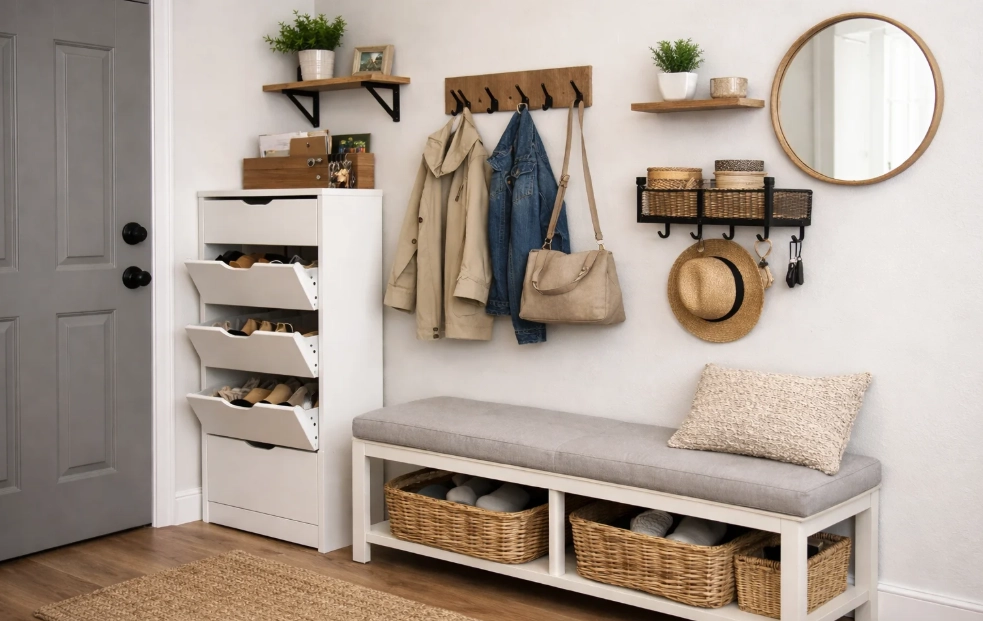
Entryway Organization FAQ
How do I stop family members from dumping shoes right inside the door?
The dump happens because the shoe spot is farther than the door swing. Move the shoe tray or rack to within one step of the threshold. If you have a bench, place a boot tray directly underneath the bench seat, not at the end of the hall. I also use a visual cue—a bright-colored tray. People aim for it without thinking.
What's the biggest entryway organization mistake you see in small apartments?
Buying a closed shoe cabinet with doors. You'll stop opening the doors after a week. Open shelves or a bench with visible shoe storage works better in small spaces because you can see the clutter and deal with it. Also, skip the umbrella stand unless you actually carry an umbrella daily. It becomes a dust collector and a tripping hazard.
Should I use baskets or bins for entryway clutter?
Bins with lids, not open baskets. Open baskets collect loose items that have no home—single earrings, old receipts, broken pens. Lidded bins force you to decide what goes inside. I use one lidded bin for "outgoing" items: library books, returns, mail to send. It gets emptied every Friday. No more than one bin. Two bins become a junk drawer on the floor.
How often should I reset my entryway organization?
Every Sunday, five minutes. Pick up anything on the floor. Return stray shoes to the bedroom closet. Wipe the key tray. That's it. Deep resets every three months aren't necessary if you maintain the weekly touch-up. The system fails when you skip two weeks in a row. I set a phone reminder for Sunday at 6 p.m.
One last thing: my entryway still gets messy on rainy days. Boots drip. Leashes tangle. I don't fight it. I keep a small towel in the bench drawer and wipe the floor when I take off my shoes. That's real life. The goal isn't a magazine photo. It's a hall that doesn't make you sigh when you walk in.
This guide reflects hands-on testing in three different homes and conversations with families who've tried these fixes. All product categories and dimensions were verified through direct measurement and use.


Comments