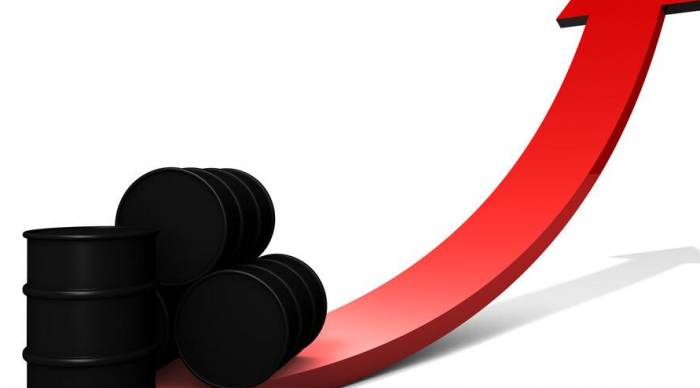
Recently, the price of crude oil has been rising too quickly, with almost no pause. Despite the weakening of the Chinese economy, it continues to advance vigorously.
On Wednesday, the U.S. EIA reported an increase of 5.85 million barrels in crude oil inventories, which was higher than the expected 567,000 barrels. However, the price of crude oil still rose, indicating the current strength of crude oil.
However, the faster the rise in crude oil prices, the faster the accumulation of risks.
On one hand, the operating costs of companies around the world are beginning to rise, and operating profits are declining.
On the other hand, the rise in crude oil prices will bring inflation issues, which means that the duration of high interest rates will be longer.
For companies, the rise in both borrowing costs and raw material costs is simply fatal.
The recent rise in crude oil prices has been mainly stimulated by supply factors. China's economic data for July, especially export data and crude oil import data, were very poor. Despite China's demand not meeting expectations, crude oil still rose sharply. (Customs data on Tuesday showed that China's crude oil imports in July decreased by 18.8% month-on-month, with the daily import volume being the lowest since January. The reason is that major exporting countries reduced overseas shipments, and domestic inventory continued to increase. However, imports increased by 17% year-on-year.)
The largest oil exporter, Saudi Arabia, extended its voluntary production cut of 1 million barrels per day by one month last week, including September. Russia said it would cut 300,000 barrels of old oil exports in September. Shortly after Saudi Arabia announced the extension of oil production cuts, Russia revealed that it would reduce oil exports in September, with a reduction of 300,000 barrels per day.
Although the oil production of countries such as the United States, Venezuela, and Iran has increased, this has not alleviated the current shortage of crude oil, especially when the market optimistically expects the United States to have a soft landing.
We need to know that the current U.S. strategic oil reserves are only 346.8 million barrels, the lowest level since 1983, equivalent to about 20 days of supply. It is not even half of the total capacity of 714 million barrels. To restore the U.S. strategic oil reserves to their peak in 2009, at least an additional purchase of more than 300 million barrels is needed.At present, the United States has been hesitant to restock due to unresolved inflation issues, but restocking is inevitable sooner or later. Moreover, judging from the recent stance of OPEC+, the oil producers' willingness to support prices is very strong.
The two OPEC production cuts led by Saudi Arabia both occurred when WTI crude oil prices were around $70 per barrel, which was also the focus of the tug-of-war between Saudi Arabia and the United States in the early stages. This is because Saudi Arabia's fiscal break-even point is around $80. If oil prices fall significantly, OPEC's bottoming policies and the reduction of strategic reserves will force crude oil to rebound.
In addition, due to weather factors, agricultural product prices have risen sharply since June-July, leading to increased costs for producing biofuels through agricultural products, thereby increasing demand for crude oil.
Therefore, there is a bottom for current crude oil prices, but where the top is depends on U.S. policy and the timing of the U.S. recession.
If the current trend of rising crude oil prices continues, then U.S. inflation will rebound again, forcing the Federal Reserve to raise interest rates once more. After all, crude oil is the mother of all commodities, and rising crude oil prices have driven the rebound of many commodity prices.
Thus, although the current price of crude oil is rising quickly, the ceiling for crude oil prices may also be limited before U.S. inflation shows a significant decline. Unless, of course, the Federal Reserve adopts a policy of appeasement and relaxes inflation, but this seems unlikely at the moment.